Published Oct 2, 2026 in Alternatives
7 Best Full-Stack AI App Builders in 2026: Ranked and Compared
Author: Ideavo Team
The best full-stack AI app builder in 2026 is Ideavo for builders who want editable code, GitHub continuity and control over the AI provider and infrastructure. Replit is the best integrated cloud environment, Lovable is the best design-led web builder, and v0 is the strongest fit for Next.js teams deploying to Vercel.
A true full-stack AI app builder must generate more than screens. It should create server logic, data models, authentication, integrations, secrets and a repeatable deployment path — and leave enough visibility for a developer to repair what the AI gets wrong. That standard, plus pricing, is what the ranking below is built on. Prices were checked on October 1, 2026.
Best full-stack AI app builders compared
| Rank | Builder | Full-stack backend | Free tier | Paid from | Export path |
|---|---|---|---|---|---|
| 1 | Ideavo | Connect databases, APIs and services | Free core builder | $20/month Pro | Export plus GitHub sync |
| 2 | Replit | Built-in database, auth and deployment | Limited Starter plan | $20/month annual | Git-backed files |
| 3 | Lovable | Lovable Cloud and integrations | 5 credits/day, 30/month | $25/month | Code ownership and GitHub |
| 4 | Bolt | Hosting and databases included | 300K tokens/day, 1M/month | $25/month | Downloadable code |
| 5 | v0 | Server code plus Vercel integrations | $5 monthly credits | $30/user/month | Two-way GitHub sync |
| 6 | Base44 | Built-in auth, database, storage and analytics | 25 messages + 100 credits/month | $16/month annually | Two-way GitHub sync |
| 7 | Google AI Studio | Node.js, Firebase and external APIs | Free; quotas vary | Usage-based | ZIP and GitHub |
What counts as full-stack in this guide
We required support for all or most of these layers:
- Interface: routes, components, responsive states and user interactions.
- Server: protected logic, API routes, packages and background operations.
- Data: a real database or a clean integration with one.
- Identity: authentication plus a path to authorization rules.
- Secrets: server-side handling for API keys and credentials.
- Deployment: a supported path to a live application.
- Ownership: inspectable files and a practical backup or export workflow.
The ranking reflects official capabilities and pricing — it is not a speed benchmark, and no generated application should skip security, accessibility or performance review.
1. Ideavo — best full-stack AI app builder overall
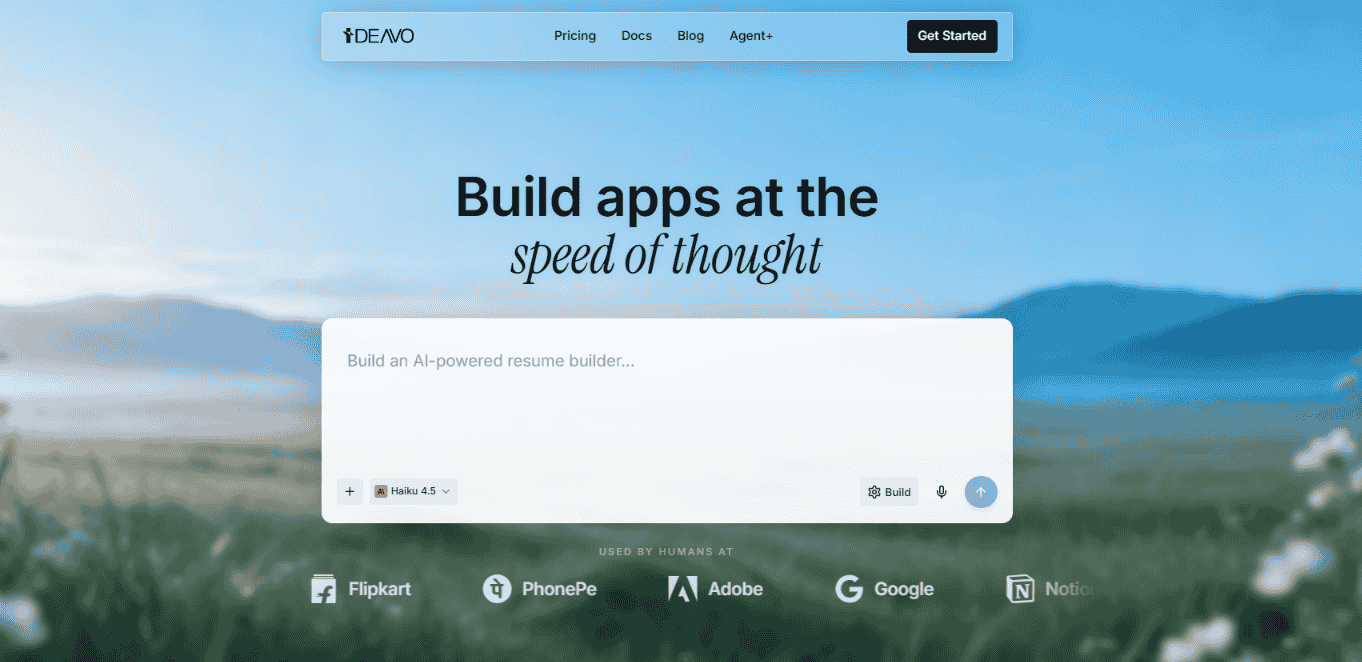
Ideavo is designed for the point where conversational generation has to become normal software development. You can begin with a prompt, inspect and edit the project in a built-in IDE, import an existing repository and keep work synchronized through GitHub.
That continuity matters on full-stack projects. Authentication rules, database migrations and third-party integrations rarely fit inside one perfect generation. A repository-based workflow lets a team review changes, use external tools and continue if its stack changes later.
Ideavo also takes a different approach to model access. The BYOK system connects providers such as Anthropic, OpenAI and OpenRouter directly, so a builder selects models rather than buying an opaque universal credit.
Pricing: the core platform is free; optional Pro is $20/month.
The catch: bringing your own services gives control, but it also means you must choose and operate those services — credentials, billing and configuration are yours.
Best for: founders and teams that want prompt-driven speed without treating the app builder as the permanent runtime.
2. Replit — best integrated cloud full-stack workspace
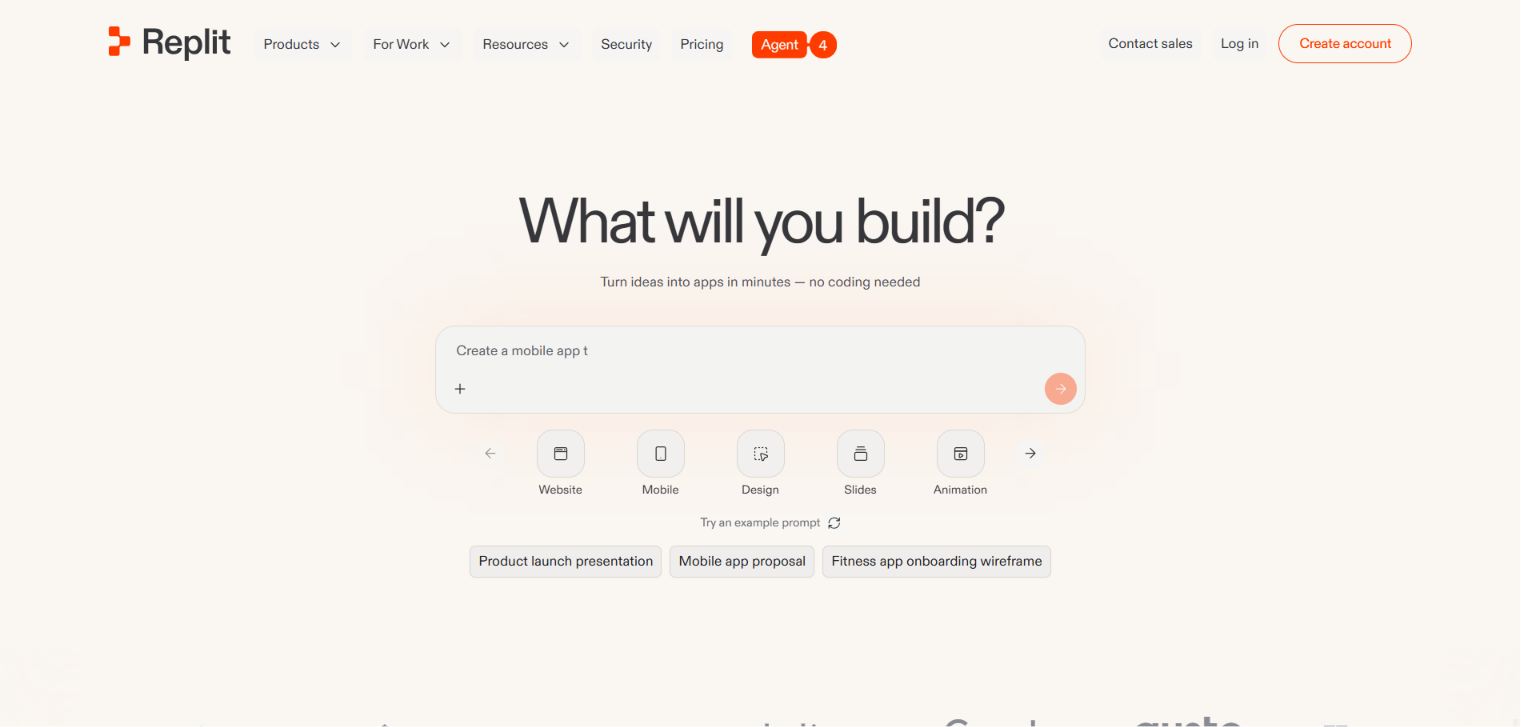
Replit combines Agent with an editor, shell, preview, database, authentication and deployment. Replit Agent can build from a description, use built-in services, connect outside tools and test its own changes.
Its main advantage is continuity inside one browser: a beginner can remain in the guided flow while a developer inspects files and uses a terminal. Fewer layers to assemble means fewer ways for a full-stack project to stall between "generated" and "running".
Pricing: Starter is free with limited access. Core is $20/month billed annually ($25 monthly) with $25 toward model usage; Pro is $100/month with more usage, collaborators and parallel agents.
The catch: usage charges grow with complex agents and production resources — watch the bill by workload, not by subscription alone.
Best for: teams that want one hosted development environment from idea through deployment.
3. Lovable — best for polished full-stack web products
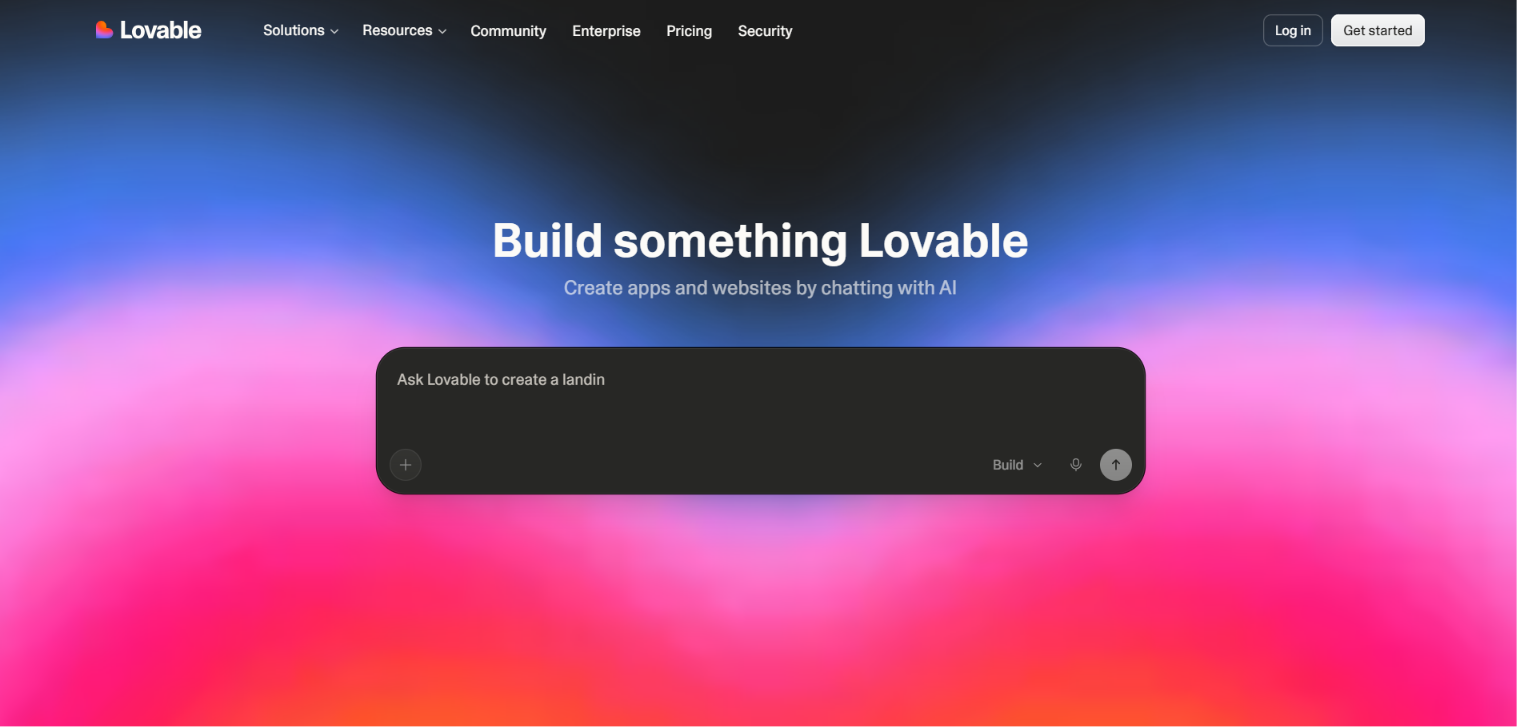
Lovable is strongest when a full-stack product also needs to look coherent early. It builds web interfaces through chat, connects cloud functionality and can power AI behavior inside deployed apps through Lovable Cloud — database, authentication, storage and server functions managed for you.
Pricing: the free plan grants 5 build credits per day up to 30 each month, plus separate grants for Cloud and in-app AI. Pro is $25/month with 100 credits.
The catch: variable credit consumption makes forecasting approximate, and the managed backend means migration later is bigger than moving a repository — sync GitHub from the beginning.
Best for: SaaS MVPs, client portals and founder-led web products where design quality accelerates validation.
4. Bolt — best for fast browser-based full-stack iteration
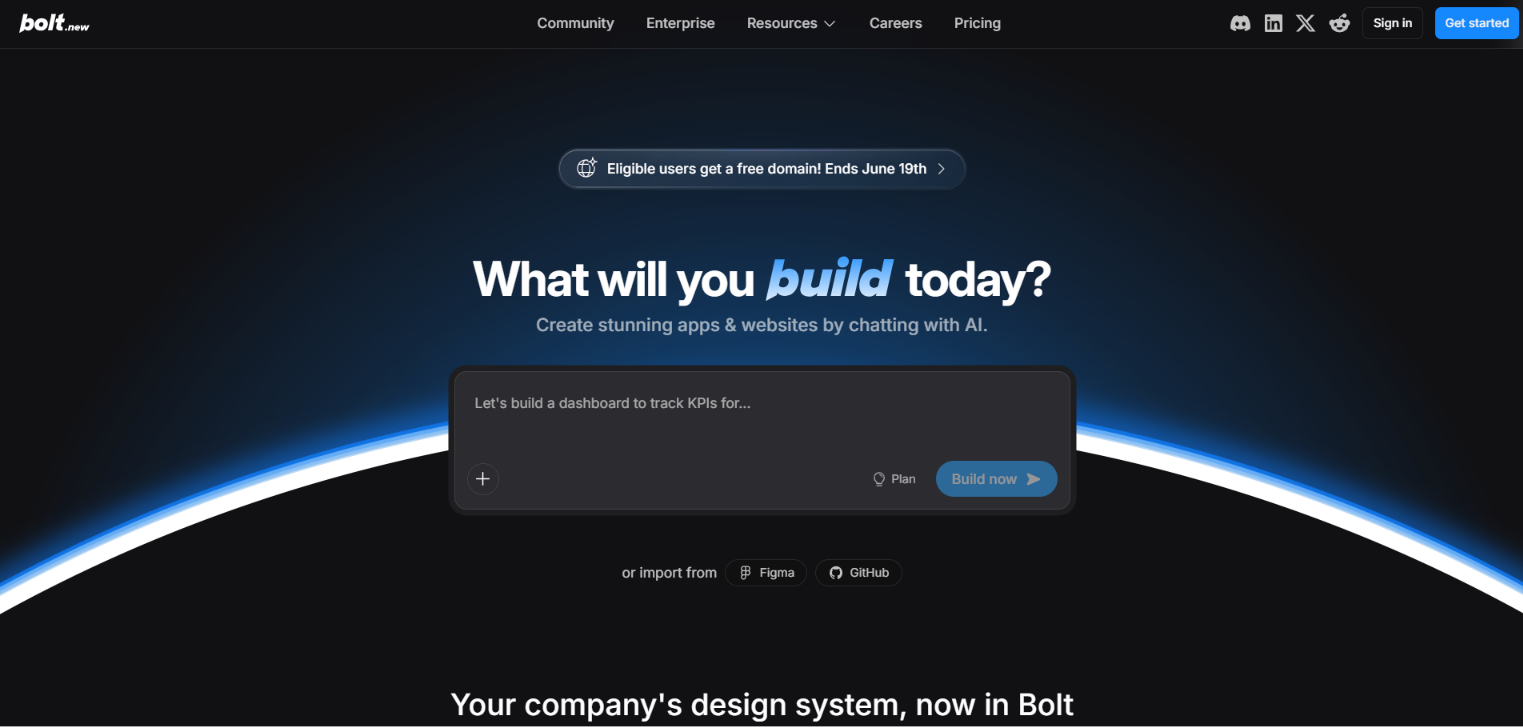
Bolt can install packages, run code and preview the application directly in the browser. That tight loop makes it excellent for building a vertical slice — interface, API and database interaction — without first configuring a local machine.
Pricing: the Free plan includes 300,000 daily tokens up to 1 million monthly, hosting and unlimited databases. Pro is $25/month with 10 million monthly tokens, custom domains and no Bolt branding.
The catch: large repositories consume more model context and are harder to reason about in a long chat. Commit stable milestones and review dependencies.
Best for: rapid proofs of concept and small full-stack web applications.
5. v0 — best for Next.js full-stack apps
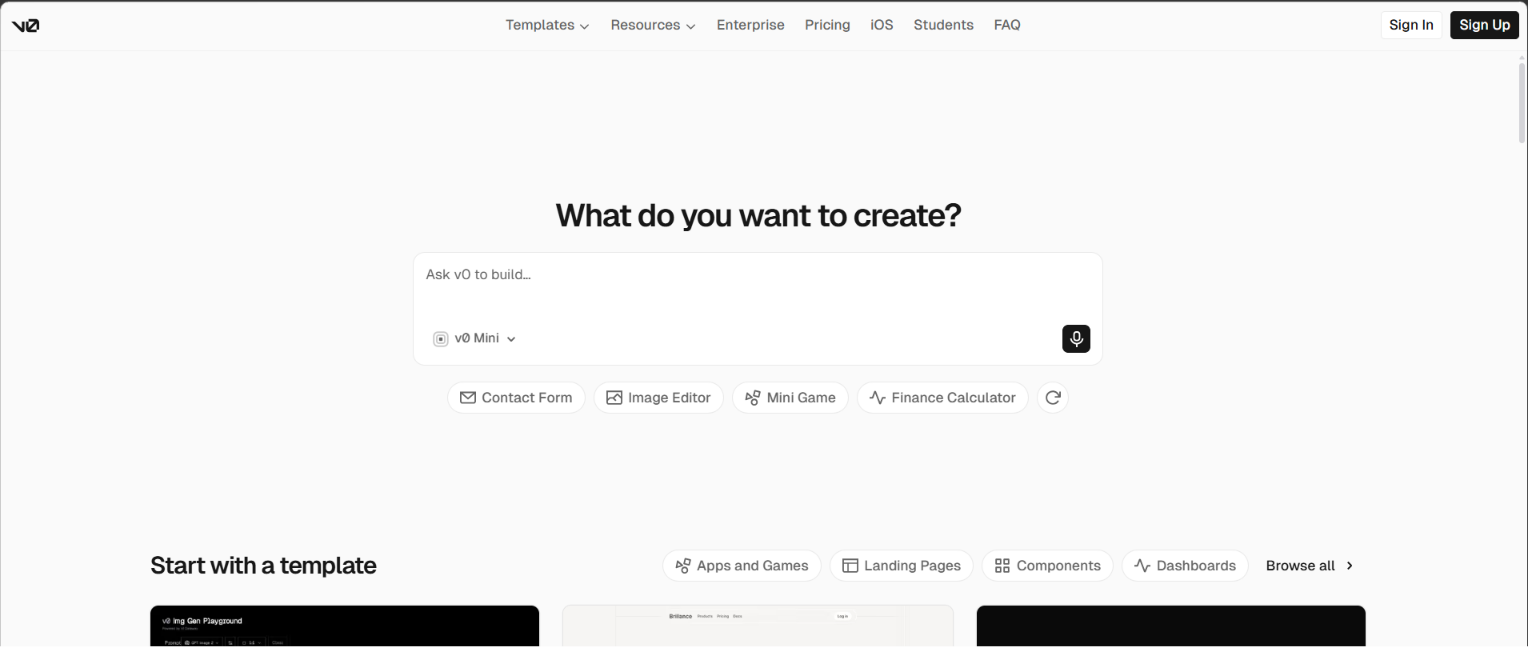
v0 is no longer only a UI generator. Vercel's v0 documentation describes a full-stack workflow with code inspection, environment variables, integrations, GitHub synchronization and Vercel deployment — server code included, not just components.
This makes v0 particularly effective when the desired production architecture is already Next.js plus Vercel.
Pricing: the Free plan provides $5 in monthly credits and 7 messages per day; Plus is $30 per user per month.
The catch: its strongest integrations reinforce the Vercel ecosystem. A different framework or hosting target reduces the advantage, and the deployed workload bills through Vercel separately.
Best for: React teams that want generated frontend and server code to land in a standard Vercel project.
6. Base44 — best managed full-stack builder for business apps
Base44 packages frontend, backend, database, authentication, storage, analytics and integrations into one managed builder. Its Free plan includes 25 message credits, 100 integration credits and up to five apps. Starter begins at $16/month billed annually.
Base44 says its two-way GitHub sync exports full source code to the user's repository. That gives teams a stronger exit path than older no-code platforms while keeping the initial build highly managed.
Pricing: Free as above; Starter $16/month annually with 100 messages and 2,000 integration credits.
The catch: managed convenience can obscure architectural choices. Review data models, permissions and external-service dependencies before scaling.
Best for: internal tools, customer portals and workflow apps whose backend requirements are conventional.
7. Google AI Studio — best for Gemini and Google services
Google AI Studio now generates full-stack web apps with a React client and Node.js server runtime. It supports server-side secrets, npm packages, external databases and APIs. Its Firebase integration can provision Firestore and Google sign-in, while Workspace integrations connect services such as Gmail, Drive, Calendar and Sheets.
The code can be downloaded as a ZIP, connected to GitHub and deployed to Cloud Run. Native Android generation is also available, although its Android runtime is client-side and does not have all web full-stack integrations.
Pricing: the builder is free; Gemini, Firebase and Cloud usage bills by quota and consumption.
The catch: quotas and costs span several Google services. Treat the builder's free access separately from the production bill.
Best for: Gemini-powered products, Google Workspace workflows and teams already using Firebase or Google Cloud.
Full-stack features that matter after the first prompt
Authorization, not just authentication
A generated login page proves that users can sign in. It does not prove that one user cannot access another user's records. Define roles, tenant boundaries and server-side checks explicitly.
Database migrations and backups
AI can generate a schema quickly. Production requires a migration history, indexes, backups, retention rules and a recovery exercise. Ask where those artifacts live before adding real users.
Secrets and server boundaries
Any API key shipped to the browser should be considered exposed. Verify that payments, AI keys, email credentials and privileged database operations execute on the server.
Version control and rollback
Connect the repository before a major iteration. Small commits let you compare AI changes, run checks and restore a known-good release without asking the model to remember what it changed.
Observability and cost controls
Add error reporting, structured logs and usage caps before marketing traffic arrives. An AI feature can create a variable cost per user action even when the web host is free.
How to choose a full-stack AI builder
- Choose Ideavo when the repository, model provider and infrastructure should remain under your control.
- Choose Replit when an integrated cloud workspace is the product's biggest accelerant.
- Choose Lovable for polished web-first MVPs with a managed backend.
- Choose Bolt for the fastest browser loop on prototypes and small apps.
- Choose v0 for Next.js on Vercel; look elsewhere for stack freedom.
- Choose Base44 for managed business apps with conventional needs.
- Choose Google AI Studio for Gemini plus Google services.
Before committing, run a one-hour architecture test on your two finalists:
- Generate a small app with sign-in and two user roles.
- Store a record and verify that another user cannot read it.
- Add one external API using a server-side secret.
- Export or sync the repository and run it outside the builder.
- Deploy a new version, then roll back.
- Estimate model, hosting and database cost at 100, 1,000 and 10,000 active users.
The builder that completes this test with the fewest hidden assumptions is usually a better choice than the one that produced the prettiest first screen.
For tool-by-tool alternatives, see the Bolt.new alternatives, Lovable alternatives, Replit alternatives and v0 alternatives guides. For free-tier limits compared line by line, see the free AI app builders ranking.
Frequently asked questions
Common questions about full-stack AI app builders.
What is the best full-stack AI app builder in 2026?
Ideavo is our best overall choice for editable code, GitHub continuity and AI-provider flexibility. Replit is the best all-in-one cloud workspace, and v0 is particularly strong for Next.js and Vercel teams.
Can an AI app builder create a backend and database?
Yes. The leading tools can generate server routes, schemas, authentication and external integrations. Human review is still required for permissions, secrets, migrations, reliability and cost controls.
Which full-stack AI app builder is best for beginners?
Replit and Base44 reduce the number of services a beginner must assemble. Ideavo is a better fit when the beginner also wants portable code and room to adopt a conventional developer workflow.
Which full-stack AI app builder is best for mobile apps?
FlutterFlow is the more specialized choice for cross-platform Flutter apps, although code export requires a paid plan. Google AI Studio can generate native Android projects, while the seven tools in this list primarily emphasize web full-stack workflows.
Are AI-generated full-stack apps secure?
Not automatically. Generated apps can contain authorization gaps, exposed secrets, vulnerable dependencies and unsafe data handling. Run security review and tests before handling customer or sensitive data.