Published Jun 14, 2026 in Alternatives
v0 vs Cursor: Which AI Development Tool Should You Use?
Author: Ideavo Team
v0 vs Cursor: quick answer
v0 and Cursor are both AI development tools, but they solve different parts of the build process.
v0 is best when you want to generate, iterate, and deploy web interfaces quickly. It is especially strong for UI-heavy work, Design Mode, GitHub sync, Vercel deployment, and web app iteration.
Cursor is best when you already work in a codebase and want an AI coding agent inside the engineering workflow: understanding files, editing across a repo, refactoring, debugging, reviewing, and maintaining software.
Ideavo is worth considering if you want the simplicity of v0, the customization and control of Cursor, and a product that is actually free. It includes unlimited projects, visual editing, GitHub export, deployment workflows, collaboration, and BYOK so you can connect your own AI key or subscription.
| Need | Best fit |
|---|---|
| Generate and deploy web UI quickly | v0 |
| Work deeply inside an existing codebase | Cursor |
| Free to use platform | Ideavo |
| Refactor, debug, and review production code | Cursor |
| Non-developer friendly | v0/Ideavo |
What v0 does well
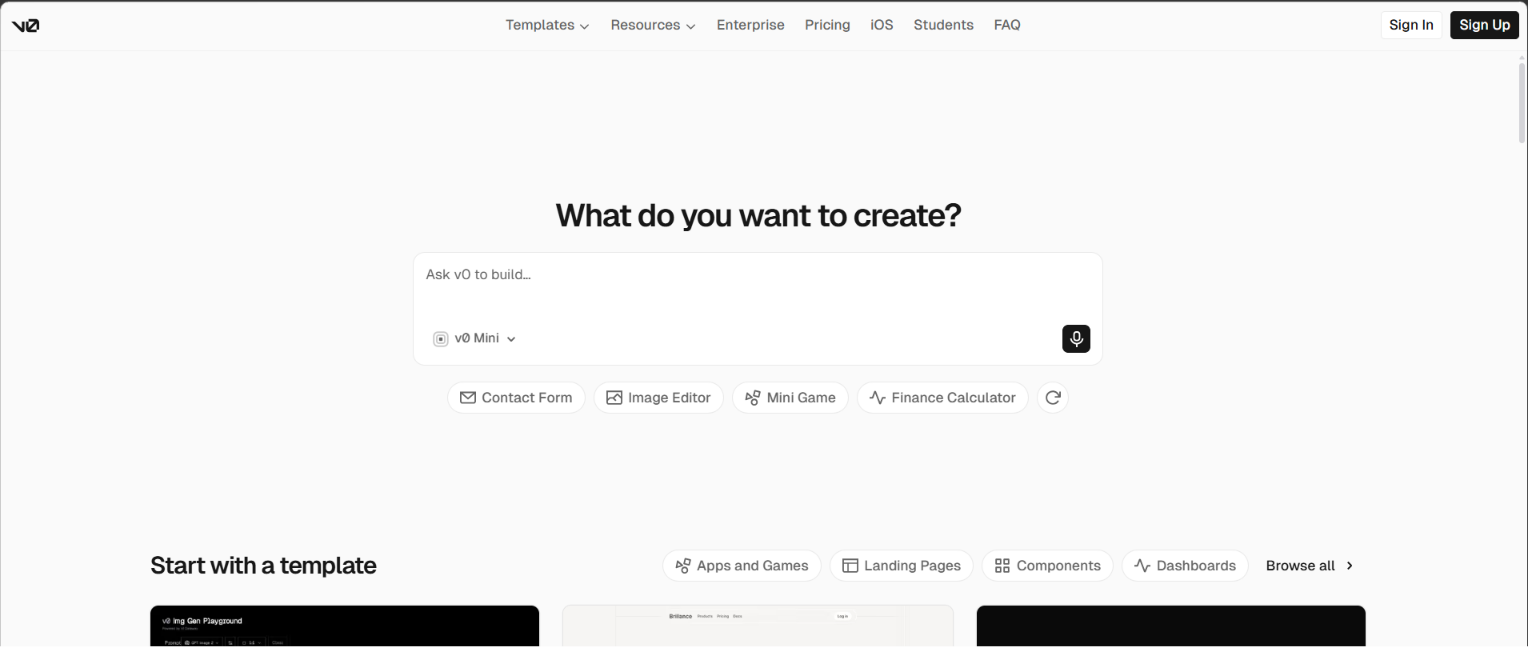
v0 is Vercel's AI assistant for designing, iterating, and scaling full-stack web applications. Its public positioning focuses on generating working applications, publishing live websites, editing visually with Design Mode, syncing with GitHub, and deploying to Vercel.
v0 is strongest when:
- You want to generate polished frontend UI from prompts.
- You want visual editing through Design Mode.
- You want GitHub sync and deployment to Vercel.
- You are building web interfaces, prototypes, landing pages, dashboards, or frontend-heavy applications.
The tradeoff is that v0 is strongest around web UI and Vercel workflows. If the project becomes a broader full-stack product or needs deep maintenance across an existing repository, a codebase-first tool may fit better.
What Cursor does well
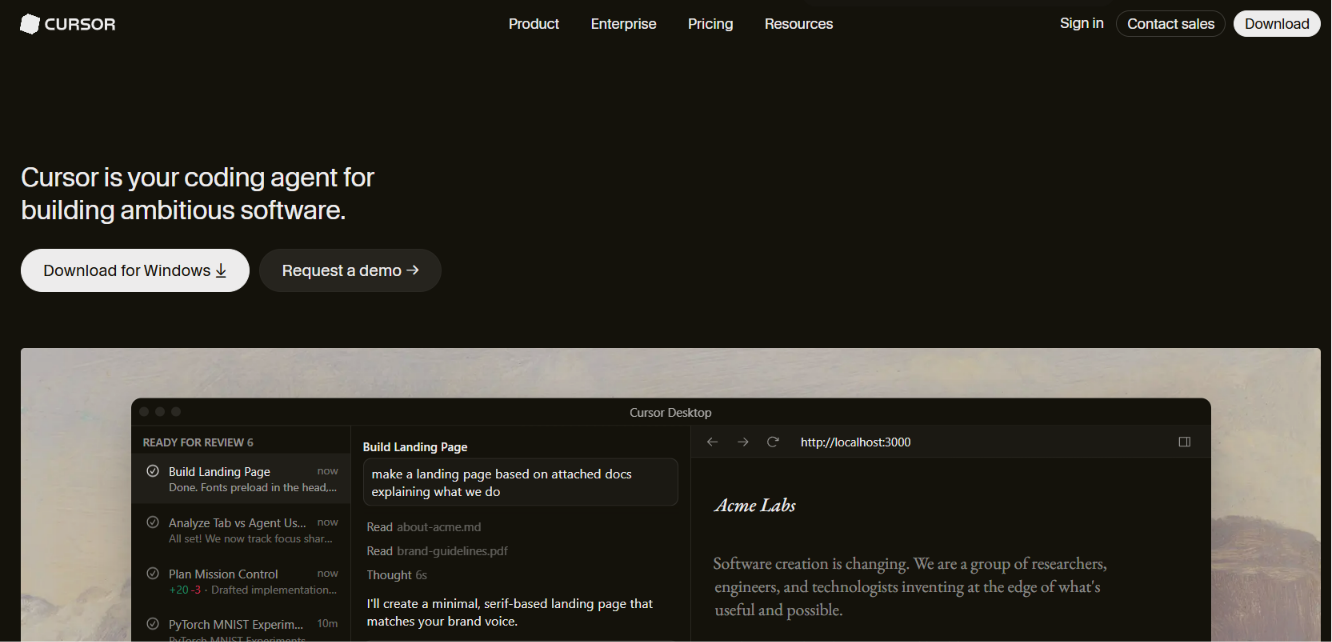
Cursor is an AI code editor and coding agent for developers and teams working in real codebases. Its strength is not replacing software engineering; it makes the engineering loop faster. Developers can ask questions about a codebase, generate multi-file changes, use autocomplete, run agentic edits, review diffs, and connect team workflows around code.
Cursor is strongest when:
- You already have a repository or know how to work inside one.
- You need AI help with refactoring, debugging, tests, reviews, and codebase understanding.
- You want to keep deployment, CI/CD, GitHub, and infrastructure in your existing stack.
- You are a developer or engineering team maintaining production software.
The tradeoff is that Cursor is code-first. It can generate app code, but it is not a full product-building platform with visual app iteration, hosting, domains, and non-technical workflows built around the first prompt.
v0 vs Cursor: main differences
| Category | v0 | Cursor | Ideavo |
|---|---|---|---|
| Core product | AI web UI and app assistant | AI code editor and coding agent | Free AI app builder for full-stack products |
| Best starting point | A web interface or Vercel app | An existing repository | A product idea or existing project |
| Primary workflow | Prompt, design, sync, deploy | Open repo, ask agent, review diff, ship | Chat, build, visually edit, export, deploy |
| Code control | GitHub sync and frontend code workflows | Strong inside local/repo workflow | Cursor-like control with GitHub export and an IDE |
| Visual editing | Design Mode | Code-first UI edits | Visual edits connected to source files |
| Deployment | Deploy apps to Vercel | Uses your existing deployment stack | Vercel, custom domains, GitHub-oriented workflows |
| BYOK | Not positioned as a core self-serve feature | Not positioned as a core self-serve feature | Connect your own AI key or subscription |
Pricing comparison
Pricing changes often, so check each vendor before buying. As of the current public pricing pages:
| Plan level | v0 | Cursor | Ideavo |
|---|---|---|---|
| Free | Free plan with included monthly credits, Vercel deployment, Design Mode, GitHub sync, and daily messages | Hobby: limited Agent requests and Tab completions | Free with unlimited projects and core features |
| Main paid plan | Team: $30/user/month with included monthly credits, shared team credits, centralized billing, and collaboration | Individual: $20/month, extended Agent limits, frontier models, MCPs, skills, hooks, cloud agents, and Bugbot usage billing | Pro: $5/month for an ad-free experience |
| Higher plan | Business: $100/user/month with training opt-out by default, shared credits, centralized billing, and collaboration | Teams: $40/user/month, centralized billing, admin, team marketplace, code reviews with Bugbot, shared context, analytics, privacy mode, and SSO | No teams plan |
v0 pricing is tied to credits, Vercel deployment, visual editing, GitHub sync, and team collaboration.
Cursor pricing is tied to developer productivity: Agent usage, completions, frontier models, code review, cloud agents, team controls, and enterprise governance.
Ideavo's pricing story is different: the product is free with unlimited projects and core features included. The optional Pro plan is $5/month for an ad-free experience. BYOK is also central, so builders can connect an existing API key or subscription from providers such as OpenAI, Anthropic, Google, OpenRouter, OpenCode, Kimi, or other providers when they want direct model choice and transparent AI costs.
Which tool is easier?
v0 is easier than Cursor for generating web UI and shipping through a Vercel-centered workflow. It is built around prompts, visual iteration, GitHub sync, and deployment.
Cursor is easier for developers who already live in repositories. It fits familiar engineering habits: inspect code, ask for a change, review the diff, test, commit, and deploy through your normal stack.
Ideavo is designed for the middle ground: non-technical builders get the simplicity of chatting with AI for free with unlimited projects, while technical users keep Cursor-like control through source code ownership, GitHub workflows, export, deployment controls, and their own model provider setup.
Which tool gives more control?
Cursor gives the most control inside a codebase. If you know what files, tests, branches, and deployment systems matter, Cursor is excellent for focused engineering work.
v0 gives useful control inside web UI and Vercel workflows, especially when the product is frontend-heavy.
Ideavo gives you v0-like simplicity without giving up Cursor-like control. You can generate the app, visually edit UI details, connect GitHub, export code, deploy, manage secrets, work with teammates, run parallel tasks, connect MCP servers, and bring your own AI provider credentials.
Final recommendation
Choose v0 if you want to generate frontend-heavy web interfaces quickly, visually iterate, sync with GitHub, and deploy through Vercel without starting in a traditional code editor.
Choose Cursor if you are a developer or engineering team working in real codebases and need AI help with coding, refactoring, debugging, code review, and maintenance.
Choose Ideavo if you want a free app builder with v0-like simplicity, Cursor-like customization and control, unlimited projects, visual editing, source code ownership, GitHub workflows, deployment flexibility, collaboration, and BYOK in one workflow.
The best choice is not the tool with the longest feature list. It is the one that matches where your work actually happens: the interface builder, the codebase, or the full product-building workflow.
Frequently Asked Questions
Quick answers for builders comparing v0, Cursor, and Ideavo.